Decision frame
File quickly, but disclose generously
A provisional is useful when speed matters, but every important feature still needs enough support in text or figures.
Use the stricter standard when practical
Figures that already look like non-provisional drawings are easier to reuse and easier for reviewers to understand.
Do not add new content later
Cleaning up form is different from adding subject matter. Missing features can lose the early date.
Core difference
Disclosure vs compliance
The core difference is simple: a provisional application exists to preserve an early disclosure date, while a non-provisional application is examined and must support claims under the formal patent process.
A provisional application under 35 U.S.C. 111(b) needs a specification and any required drawing, but it does not require claims and is not examined on the merits. A non-provisional application under 35 U.S.C. 111(a) moves into examination, where formal drawing problems can become objections or requirements.
That means provisional vs non-provisional patent drawings are not interchangeable. Provisional drawings must disclose enough. Non-provisional drawings must disclose enough and comply with the formal drawing standard.
Design patent exception
USPTO guidance states that provisional applications may not be filed for design inventions. Design patent drawings should be handled under design patent rules, not provisional practice.
At a glance
Provisional vs non-provisional patent drawings
| Aspect | Provisional | Non-provisional |
|---|---|---|
| Primary purpose | Establish an early disclosure date for subject matter shown or described in the filing. | Enter examination, support claims, and move toward an issued utility patent. |
| Formal drawing review | Not examined for patentability or formal drawing compliance during its year of pendency. | Examined, with drawing objections or requirements raised when figures do not comply. |
| 37 CFR 1.84 | Useful as a best-practice target, but not usually enforced as a provisional formality. | The operative drawing standard for sheet size, margins, line quality, views, labels, and corrections. |
| Reference numerals | Strongly recommended for clarity and later reuse, especially for claim-relevant parts. | Expected as part of formal drawing/specification practice, with consistent use across views and text. |
| Views | Enough views to disclose the invention and support later claims. | Enough views to show the claimed invention clearly and satisfy examiner review. |
| Line quality | Legible sketches, scans, CAD renders, photos, and software figures can be useful if clear. | Clean black linework with reproducible, uniformly thick, well-defined lines is safer. |
| Main risk | Thin disclosure that cannot support the later non-provisional claims. | Drawing objections, replacement-sheet work, prosecution delay, and unsupported claim scope. |
Formality
How 37 CFR 1.84 applies
37 CFR 1.84 is the USPTO drawing standard for utility and design patent applications. It covers sheet size, margins, black ink, line character, scale, views, photographs, legends, and reference characters.
Because provisional applications are not examined on their merits, those formal drawing rules are not usually tested during provisional pendency. The rule still matters because a figure set that already follows it is easier to reuse when the non-provisional application is prepared.
For a full requirements checklist, start with the USPTO patent drawing requirements guide.
Reference characters
Reference numerals and consistency
In provisional drawings, reference numerals are usually a clarity tool. In non-provisional drawings, they are part of the formal figure/specification system. They identify claim elements, keep the same part consistent across views, and help the examiner read the claims against the drawings.
The safest approach is to number important components in the provisional. That makes the later non-provisional easier to write and reduces ambiguity about what each view shows.
Views
Number of views
A provisional can sometimes rely on fewer views if the invention is clear. But fewer views can be risky if hidden, internal, or alternate features matter later. A non-provisional generally needs enough views to show the claimed invention fully.
The practical question is the same at both stages: what views are needed to understand the invention? Perspective, side, top, section, exploded, detail, flowchart, and block diagram views each solve different disclosure problems. If you are choosing an actual figure count, use the how many drawings for a provisional patent guide.
Line quality
Line quality, format, and text
Provisional figures can be sketches, scans, CAD renders, photos, or software-generated drawings if they make the invention clear. Non-provisional drawings need stronger reproduction characteristics: clean black lines, legible labels, consistent scale, and minimal text.
Suitable legends may be used where necessary for understanding, but drawings should not become text-heavy substitutes for the written description. Use the figure to show structure and the specification to explain it.
Timing
Examination and consequences
A provisional is filed and then expires unless a related non-provisional is filed or the provisional is converted under the applicable rules. It is not examined on its merits, so drawing issues often remain invisible until later.
A non-provisional is examined. If drawings do not comply, the USPTO can raise objections or requirements and ask for corrected sheets. Those corrections can fix form, but they cannot add missing subject matter.
New matter
The conversion trap
The later non-provisional can rely on the provisional date only for subject matter the provisional disclosed. Under 35 U.S.C. 132, amendments cannot introduce new matter into the disclosure.
That is why incomplete provisional drawings are dangerous. You may be able to clean up linework, improve labels, or reformat sheets later, but adding a previously missing mechanism, view, or embodiment can lose the earlier priority support for that content.
Decision rule
Which standard should your drawings meet?
If the invention has meaningful visual structure, prepare the provisional drawings as if they may need to become the non-provisional drawings. That gives you stronger disclosure today and less rework later.
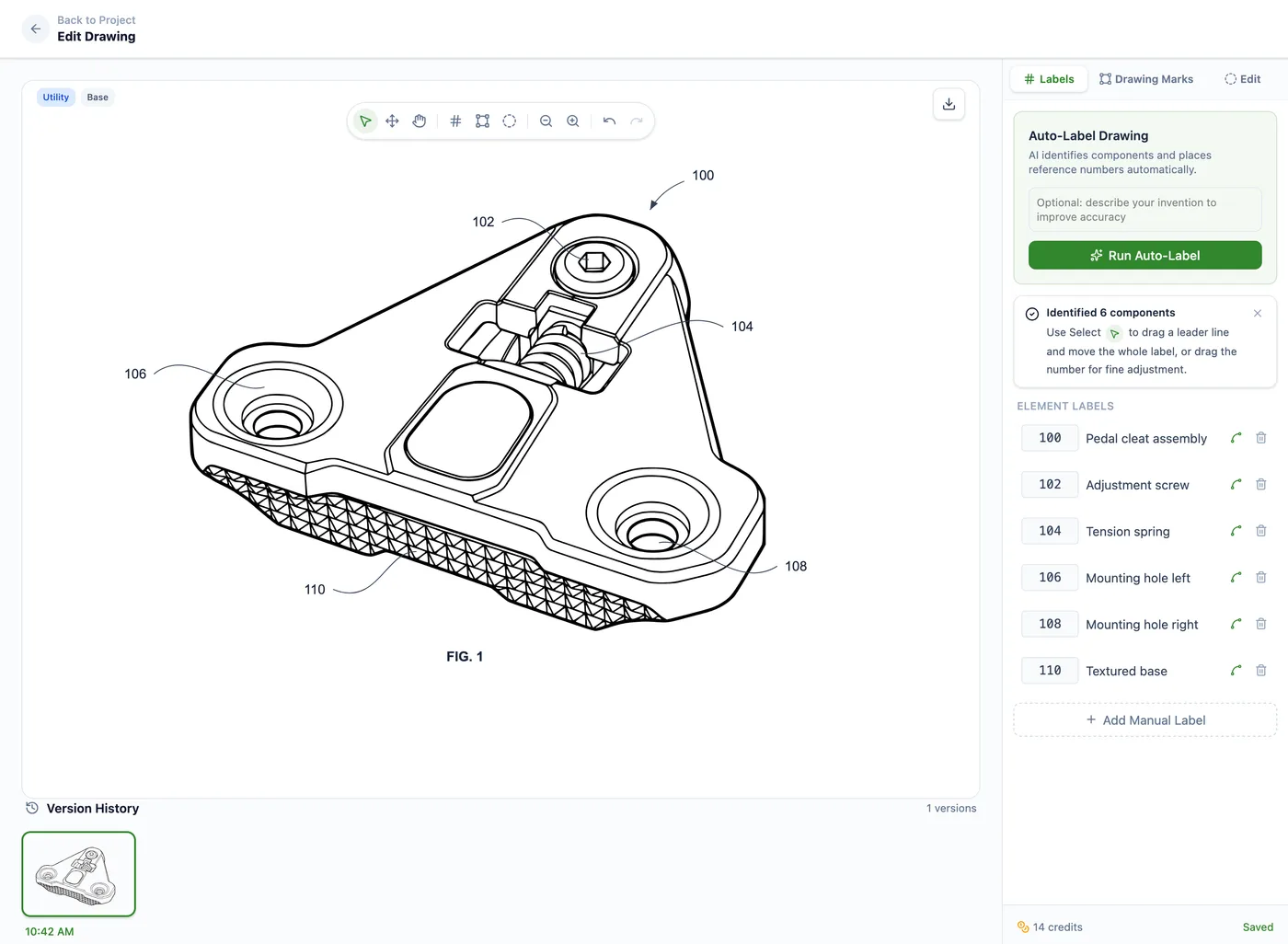
PatentDrawingAI is built for that path: upload a sketch, product photo, or CAD render as an image, create filing-ready line art in about 1-3 minutes per figure, add reference labels and drawing marks, assemble sheets, and export PDF, PNG, or SVG.
For the detailed provisional checklist, read provisional patent drawing requirements. For the non-provisional side, read utility patent drawings.
PatentDrawingAI drawing editor
Practical recommendation
Use the stricter drawing standard when time allows. It reduces conversion risk, makes review easier, and can save the cost of reworking the same figures later.
Common mistakes
Treating the provisional as informal notes
A provisional is a disclosure document. If the figures are too thin, they can limit what the later application can safely claim.
Skipping views to save time
A missing section, angle, exploded view, or diagram may become new subject matter when you try to add it later.
Waiting to number parts
Reference numerals make the figures and written description easier to align, even when they are not the provisional-stage bottleneck.
Assuming design patents work the same way
USPTO guidance states that provisional applications may not be filed for design inventions.
Sources
Quick references
These primary sources support the legal and procedural claims in this comparison.
Related guides
Provisional Patent Drawing Requirements
The deeper guide to provisional drawing requirements, priority support, and filing-date risk.
Utility Patent Drawings
How non-provisional utility drawings use views, labels, hatching, and linework to support claims.
How Many Drawings for a Provisional Patent?
A focused guide to deciding whether a provisional needs 1-2 figures, 3-6 views, or a fuller drawing set.
Patent Drawing Rules and Guidelines
The hub for USPTO drawing rules, 37 CFR 1.84 formatting, sheet standards, and examiner issues.
How to Make Patent Drawings
A practical workflow for building filing-ready patent drawings from source images.
Make drawings once, use them across the filing path
Create filing-ready figures from sketches, photos, or CAD renders, then label, assemble, and export them for review.
Try PatentDrawingAIFrequently asked questions
No. Provisional applications are not examined for formal drawing compliance, so 37 CFR 1.84 is not usually enforced at that stage. The drawings still need to clearly disclose the invention, and using 37 CFR 1.84 as a target can make later reuse easier.
Yes, if the drawings are complete enough and can be brought into formal compliance. Reuse is much easier when the provisional drawings already have clean linework, consistent reference numerals, and enough views.
The rules do not ban hand drawings, but non-provisional drawings must still satisfy reproduction, line-quality, lettering, and formatting standards. Software-generated or professionally prepared line art is usually safer.
Only if the provisional drawings are incomplete or do not meet the formal standard needed for examination. You can improve form, but you cannot add subject matter that was missing from the provisional disclosure.
No. USPTO guidance says provisional applications are not examined on their merits. Drawing adequacy often becomes important later, when the non-provisional relies on the provisional for priority support.
No. USPTO guidance states that provisional applications for patent may not be filed for design inventions.