In This Guide
Quick Summary
Patent drawings are legal documents, not illustrations. The USPTO, EPO, PCT, and WIPO each enforce specific technical standards, and the differences are large enough that drawings accepted in one office can be rejected in another. This guide covers each jurisdiction's requirements, the side-by-side comparison, common rejections, and how to design a single drawing set that satisfies multiple offices.
Need a refresher on the underlying rules? Read the patent drawing rules and guidelines reference for the full picture, or jump straight to the office-specific deep dives below.
Why Patent Drawing Requirements Matter
Patent drawings are not mere illustrations. They are legal documents that form the backbone of patent prosecution. A rejected drawing can delay your application by months, increase legal fees, and weaken the practical scope of your patent's claims. Patent examiners across the USPTO, EPO, PCT, and WIPO review drawings against strict technical specifications, and non-compliance is grounds for formal office actions and refusal to publish or grant.
Understanding these requirements before filing saves time, reduces costs, and shortens the path to grant. Yet the specifications vary significantly across offices. A drawing acceptable to the USPTO may be rejected by the EPO. A PCT drawing may not meet national-office requirements without rework. This guide breaks down the technical standards for each jurisdiction and shows you how to design drawings that work across multiple patent systems.
The Cost of Non-Compliance
- Prosecution delays: office actions or formal defect notices can pause examination until corrected drawings are filed.
- Attorney fees: redrawing and responding to formal objections can add professional time and filing overhead.
- Publication and processing delays: formal drawing defects can require corrected materials before the application proceeds normally.
- Claim weakening: informal amendments to drawings may force narrowed claims.
- Increased rejection risk: examiners scrutinize non-compliant drawings more closely, often surfacing substantive rejections downstream.
Key takeaway
Patent drawings are formal legal documents. Compliance with office-specific technical standards is mandatory, not optional. A single non-compliant figure can trigger an office action and delay your entire application.
Deep-dive guides by patent office
For detailed, rule-by-rule breakdowns of each office's requirements:
USPTO Patent Drawing Requirements (37 CFR §1.84)
The USPTO's drawing requirements are codified in Title 37, Code of Federal Regulations, Section 1.84 and elaborated in the Manual of Patent Examining Procedure (MPEP §507 and §608). These rules are among the most detailed and prescriptive in global patent law.
Paper and margins (37 CFR §1.84(a)-(b))
- Paper size: US Letter (8.5 × 11 inches) or ISO A4 (210mm × 297mm).
- Top margin: 2.5cm (~1.0 inch).
- Left margin: 2.5cm (~1.0 inch).
- Right margin: 1.5cm (~0.6 inch).
- Bottom margin: 1.0cm (~0.4 inch).
- Paper quality: white, smooth, non-gloss paper similar to standard copy paper.
Ink and line quality (37 CFR §1.84(c)-(d))
- Color: black ink only (color drawings require a petition to the USPTO and are rare).
- Line thickness: uniformly thick, solid lines; no faint or discontinuous lines.
- Durability: lines must be permanent and not fade or smudge.
- Quality standard: drawings must be suitable for reproduction and legible when reduced to 2/3 scale.
Figure numbering and reference numerals (37 CFR §1.84(e)-(f))
- Figure numbering: sequential (Fig. 1, Fig. 2, Fig. 3…), not Fig. A/B or Roman numerals.
- Placement: figure numbers appear below the figure in a centered caption (e.g., "FIG. 1").
- Reference numerals: all elements must be labeled with reference numerals (10, 20, 30…).
- Specification match: every reference numeral in the drawing must be defined in the specification.
- Font size: reference numerals must be legible, typically 8pt-12pt in final submission.
Scale and views (37 CFR §1.84(g)-(j))
- Scale: drawn to a scale that permits legibility at 2/3 reduction (the patent office copying size).
- Proportionality: elements roughly proportional unless otherwise indicated.
- Views: as many views as necessary to fully show the invention (plan, elevation, isometric, cross-section).
- Cross-sections: line-shading (cross-hatching) indicates material; must be uniform and not too dense.
- Abbreviations: common abbreviations allowed (e.g., "VIEW A-A"), but no unnecessary text.
Text and annotations (37 CFR §1.84(l)-(m))
- Minimal text: only essential labels, abbreviations, and reference legend.
- No descriptive text: descriptions of the invention belong in the specification, not on the drawing.
- Common terms: "View A-A", "Section B-B", "Detail of X" are acceptable.
- Standard fonts: Roman or sans-serif; not stylized or decorative fonts.
Pro tip: plan for reduction
The USPTO reduces drawings to 2/3 scale for copying and publication. When creating your original drawings, ensure all elements, including line thickness, reference numerals, and hatching, remain legible at 66% of original size. Test by shrinking a PDF to 2/3 scale and reviewing on screen.
EPO Patent Drawing Requirements (Rule 49 and OJ 2025)
The European Patent Office (EPO) applies application document requirements under Rule 49 EPC, supplemented by the President's 2025 decision on presentation of application documents and the EPO's September 2025 notice on color and greyscale drawings. EPO practice is generally stricter than USPTO practice on format and amendments, and electronic filings made on or after October 1, 2025 may contain color or greyscale drawings.
Paper and usable surface (Rule 49 and OJ EPO 2025)
- Paper size: ISO A4 only (210mm × 297mm); US Letter is not accepted.
- Usable surface: 26.2cm (width) × 17cm (height), roughly 10.3 × 6.7 inches.
- Margins: implicit; drawings must fit within the usable surface area.
- Numbering area: page numbers and office reference markings appear outside the usable area.
Color support (October 2025 update)
Effective October 1, 2025, the EPO permits color and greyscale drawings in electronic filings. This comes from the EPO's 2025 presentation-of-documents decision and follow-up notice. Black-and-white drawings remain acceptable, and applicants should be careful about relying on color-specific features in the description, claims, or abstract.
- Color is optional: black-and-white drawings remain fully acceptable.
- Use with care: the EPO advises applicants not to rely on color-specific descriptions when those colors may not be reliably identifiable.
- Electronic filing required: the EPO permits color and greyscale drawings when filed through supported electronic filing channels.
- PCT exception: PCT international-phase color drawings are rendered in black and white for international processing and publication.
Line quality and reproduction
- Line quality: durable, sufficiently dark, uniformly thick, and well-defined.
- Black ink: solid black for reproducibility; no fading.
- Quality standard: clear, legible, and suitable for electronic scanning and publication.
Numbering and reference numerals
- Figure numbering: sequential Arabic numerals (Fig. 1, Fig. 2…); placed below or to the side of each figure.
- Reference numerals: all parts labeled; must match the description in the specification.
- No descriptive labels on drawings: strictly enforced; words like "motor", "frame", "bearing" are not allowed.
- Legends and keys: if necessary, placed separately, not embedded in the figure area.
Amendments and added-matter risk
The EPO's amendment rules for drawings are notably stricter than the USPTO's:
- Original submission: drawings must be submitted in the earliest possible version (application filing or at EP phase).
- Minor amendments only: allowed only if they do not go beyond the disclosure of the original application.
- No new elements: cannot introduce new structural elements, proportions, or details that were not disclosed in the original drawings.
- Examination phase restriction: stricter interpretation once examination has begun; examiners often object to amendments.
- Formal defect route: major drawing amendments may be treated as formal defects requiring correction at later stages.
EPO vs USPTO: amendment philosophy
The EPO discourages amendment of drawings after filing, treating drawings as fixed evidence of disclosure. The USPTO is more flexible, allowing clarifying amendments during prosecution. Plan your EPO drawings carefully before filing.
PCT Patent Drawing Requirements (Rule 11 PCT)
The Patent Cooperation Treaty (PCT) provides a unified filing framework administered by WIPO. PCT drawing requirements are codified in Rule 11 of the PCT Regulations and the PCT Administrative Instructions (Section 302). These standards are generally aligned with EPO and WIPO and are sometimes stricter than national offices.
Paper and physical format (Rule 11 PCT, Admin. Instr. 302)
- Paper size: ISO A4 (210mm × 297mm) mandatory.
- Margins: top 2.5cm, left 2.5cm, right 1.5cm, bottom 1.0cm for drawing sheets.
- Page numbering: required; centered at bottom in margins.
- Electronic submission: PDF or TIFF format required for e-filing; no compressed formats.
Line quality and shading (Rule 11 PCT)
- Black ink: uniform, solid black lines.
- Line thickness: suitable for reproduction at 2/3 scale.
- Shading / hatching: allowed for cross-sections; must be uniform and not excessive.
- No color: at PCT phase, color is not permitted in the international phase. Offices may apply their own rules later in the national or regional phase.
Numbering and captions (Rule 11 PCT)
- Figure numbering: Arabic numerals starting from 1; centered caption below each figure.
- Reference numerals: all elements labeled; sizes must be appropriate for legibility.
- Specification alignment: every reference numeral must be described in the specification.
Receiving office checks (PCT phase)
The International Preliminary Examining Authority (IPEA) or Receiving Office performs formal checks on PCT drawings. Common rejections include:
- Missing figure numbers or non-sequential numbering.
- Reference numerals not defined in the specification.
- Illegible text or numerals due to reduction.
- Improper margins or page size.
- Low-quality scans or faint lines.
PCT strategy: design to the strictest standard
The PCT serves as a gateway to multiple national offices. When filing via PCT, design drawings to meet the strictest standards, often EPO or PCT. This minimizes the need for amendments during national phase and accelerates grant across jurisdictions.
WIPO Standards: The International Baseline
The World Intellectual Property Organization (WIPO) administers the PCT and operates as a mediator for international patent standards. WIPO's role is to set a global common denominator that accommodates all member offices while maintaining quality and uniformity.
WIPO's drawing governance
WIPO does not operate its own patent office, but sets standards that PCT applicants must follow:
- PCT Regulations: Rule 11 and PCT Administrative Instructions Section 302 are WIPO standards.
- International publication: WIPO publishes PCT applications, applying strict formatting checks.
- National phase guidance: WIPO's PCT Applicant's Guide provides detailed drawing guidance aligned with major offices.
- Harmonization role: WIPO encourages member offices to adopt compatible standards but acknowledges national variations.
Key WIPO principles
- Clarity and legibility: drawings must be clear and unambiguous.
- Reproducibility: must survive scanning and digital reproduction.
- Minimal text: only labels and essential annotations.
- Proportionality: elements should be roughly proportional unless otherwise noted.
- Electronic-ready: modern WIPO expects high-quality PDF or TIFF originals.
Complete Comparison: USPTO vs EPO vs PCT vs WIPO
The following table compares drawing requirements across all four major patent jurisdictions. Where offices align, we note it; where they diverge, the key difference is called out directly.
| Requirement | USPTO | EPO | PCT | WIPO |
|---|---|---|---|---|
| Paper size | US Letter or A4 | A4 only | A4 only | A4 (recommended) |
| Top margin | 2.5cm (1.0") | Part of usable surface | 2.5cm | 2.5cm |
| Left margin | 2.5cm (1.0") | Part of usable surface | 2.5cm | 2.5cm |
| Right margin | 1.5cm (0.6") | Part of usable surface | 1.5cm | 1.5cm |
| Bottom margin | 1.0cm (0.4") | Part of usable surface | 1.0cm | 1.0cm |
| Ink color | Black (color rare, by petition) | Black; color/greyscale if e-filed* | Black only | Black |
| Line quality | Uniform, solid, 2/3-scale legible | 0.5–0.7mm, clean, scan-ready | Solid, uniform, 2/3-scale legible | Clear, uniform, reproducible |
| Figure numbering | Sequential Arabic (Fig. 1, Fig. 2…) | Sequential Arabic (Fig. 1, Fig. 2…) | Sequential Arabic | Sequential Arabic |
| Reference numerals | All elements labeled; must match spec | All labeled; no descriptive words | All labeled; match spec | All labeled; match spec |
| Text on drawings | Minimal; no description | Strictly prohibited (no words) | Minimal; abbreviations only | Minimal; labels only |
| Cross-hatching / shading | Allowed for sections; uniform | Allowed; uniform density | Allowed; uniform | Allowed; uniform |
| Proportionality | Roughly proportional | Broadly accurate | Roughly proportional | Roughly proportional |
| Amendment after filing | Flexible; corrections allowed during prosecution | Strict; only minor, non-disclosure amendments | Restricted; national office rules apply | Depends on national office |
| E-filing format | PDF, TIFF, GIF; various formats | PDF, TIFF; high-quality digital | PDF, TIFF; no compression | PDF, TIFF (recommended) |
| Publication | 18-month publication; issued to public | 18-month publication; strict formal review | 18-month WIPO publication; then national | Depends on national office |
* EPO color and greyscale drawings are permitted for supported electronic filings made on or after Oct. 1, 2025. PCT international-phase drawings are processed in black and white.
The strictest path
For multi-jurisdiction filings, EPO and PCT requirements are often the safest formatting baseline. If your drawings satisfy those requirements, they are usually easier to adapt for USPTO filing than the other way around.
Common Drawing Rejections by Patent Office
USPTO common rejections (MPEP §608)
- Illegible at 2/3 scale: lines, numerals, or details become indecipherable when reduced.
- Non-sequential figure numbering, such as using "Fig. A" and "Fig. B" instead of "Fig. 1" and "Fig. 2".
- Reference numerals appear in the drawing but are not defined in the specification.
- Drawings exceed specified margins or lack adequate white space.
- Inconsistent line quality, such as a mix of thick, thin, faint, or discontinuous lines on the same sheet.
- Excessive descriptive text that belongs in the specification rather than on the drawing.
EPO common rejections (Guidelines Part A-IX)
- Descriptive text on drawings beyond minimal labels and abbreviations.
- Poor scan quality from faint, fuzzy, or low-contrast digital files.
- Wrong paper size, typically US Letter submitted where A4 is required.
- Amendments that go beyond the original disclosure by adding new structural elements or proportions.
- Reference numerals that are too small or poorly aligned with the elements they identify.
- Color or greyscale drawings that do not meet the EPO's electronic filing and reproduction requirements.
PCT / IPEA common rejections
- Missing or non-sequential figure numbering caught by the International Preliminary Examining Authority.
- Reference numerals too small to survive publication reduction at the international stage.
- Reference numerals in the drawings that are not defined in the international specification.
- Page numbering issues, including missing page numbers or numbers placed inside the figure area.
- Low-quality digital submission, including compressed, low-resolution, or otherwise degraded PDF or TIFF files.
Prevention strategy
The best response to drawing rejections is prevention. Before submission, verify every aspect against the relevant office's checklist: margins, figure numbering, reference numeral definitions, line quality, and file format. Have a patent professional review the drawings for formal compliance before filing.
Filing Drawings Across Multiple Jurisdictions
Design to the strictest standard
When planning a multi-jurisdiction patent strategy, for example filing in the US, EU, and PCT, design your drawings to meet the strictest office's standards first. In most cases, that is the EPO and/or PCT. If your drawings satisfy EPO and PCT formatting expectations, they are usually easier to adapt for USPTO review.
- Create original drawings meeting EPO standards: no descriptive text and high-quality digital source files.
- Verify all reference numerals are defined in the specification.
- Check margins, page size, line quality, and numbering against all offices you'll file in.
- File at PCT first, then adapt for national offices as needed.
Standardize across views
Use consistent line weights, font sizes, and numbering schemes across all figures. This improves professionalism and reduces the risk of selective rejections in any one jurisdiction.
Plan for color (EPO post-Oct 2025)
If filing electronically at the EPO after October 1, 2025, consider whether color or greyscale materially improves the drawing. The EPO warns that color-specific features may not always be reliably identifiable, so black-and-white remains the safer default for most utility drawings.
Test for scale reduction
Before final submission, print or view your drawings at 66% (2/3) scale. Verify that:
- All lines remain solid and legible.
- Reference numerals are readable (typically 8-10pt equivalent).
- Cross-hatching does not blend or become too dense.
- All fine details remain visible.
Use high-quality digital masters
In the modern era, all patent drawings should originate as high-resolution digital files:
- Use CAD software (AutoCAD, Solidworks, DraftSight) or professional vector graphics (Illustrator, Inkscape).
- Save originals as PDF or high-resolution TIFF (at least 300 DPI).
- Avoid compressed formats (JPEG, GIF) for archival; use them only as exports for preview.
- Test digital files in the target office's e-filing system before final submission.
Maintain version control
Patent prosecution often involves multiple versions of drawings. Keep detailed records:
- Original drawings submitted with initial application.
- Versions submitted in response to office actions.
- Translations for international filings (non-English drawings translated to English captions if required).
- Amendments made during prosecution.
How AI-Generated Drawings Accelerate Compliance
Creating patent drawings that meet strict office standards is time-consuming and requires specialized skills. Traditional approaches involve:
- Hiring specialized patent illustrators ($2,000-$10,000+ per drawing set).
- Multiple rounds of revision to correct office action rejections.
- Manual compliance checks against each office's rules.
- Delays in prosecution while drawings are revised.
PatentDrawingAI: a compliance-first workflow
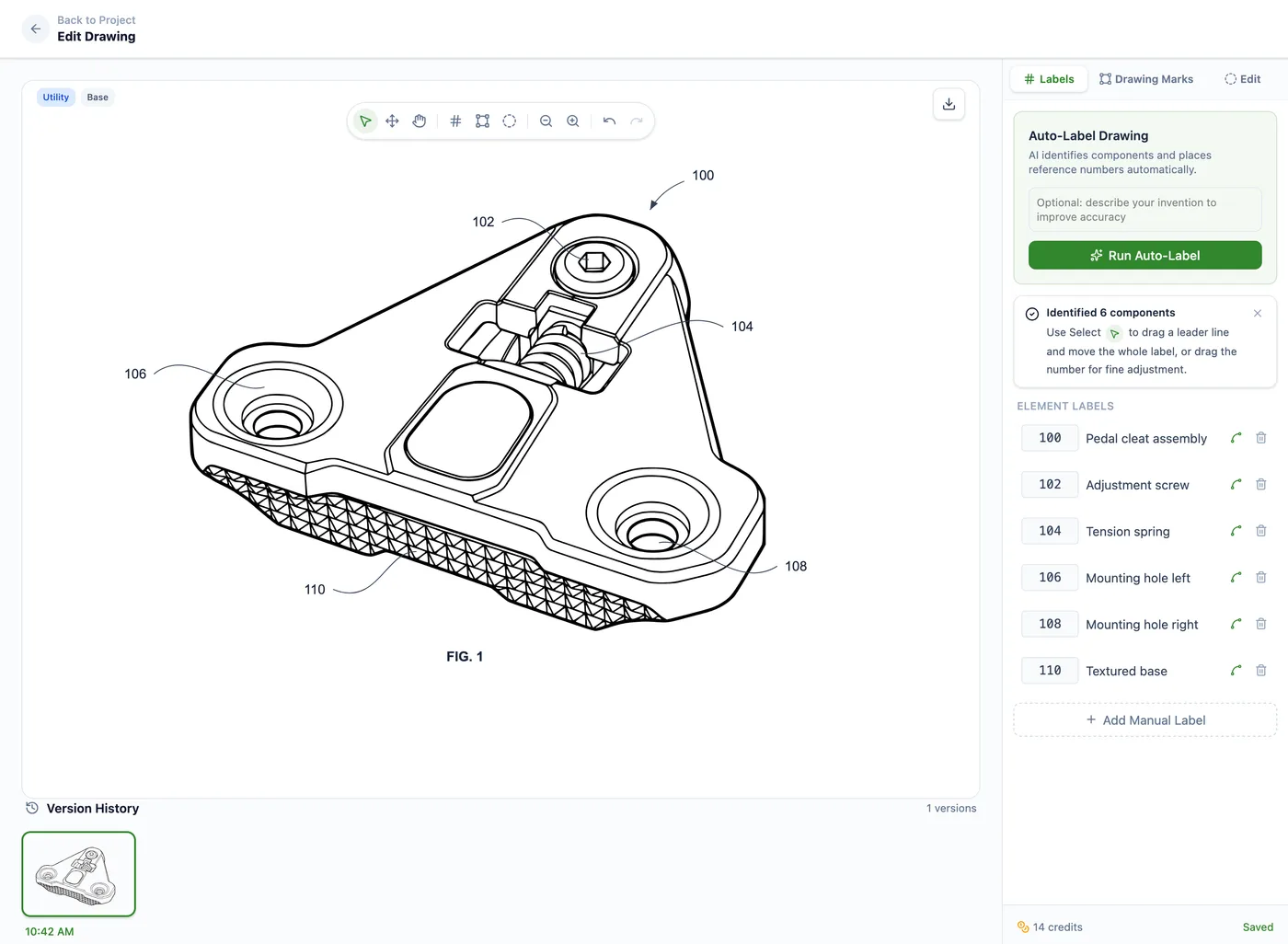
PatentDrawingAI generates drawings in 1-3 minutes per figure, formatted to align with USPTO, EPO, and PCT expectations. Upload a sketch, CAD screenshot, or prototype photo, and the AI produces clean line art with:
- Proper margins and page layout matching office standards.
- Professional line quality suitable for reduction and publication.
- Clear figure numbering and reference numeral placement ready for specification integration.
- Multiple views (plan, elevation, cross-section, detail) in a single workflow.
- High-quality digital files (PDF, SVG, PNG) optimized for e-filing.
PatentDrawingAI drawing editor
Advantages for multi-jurisdiction filing
- Speed: generate a drawing set in minutes instead of days.
- Consistency: AI maintains uniform line weight, font sizes, and numbering schemes across all figures.
- Scalability: generate multiple variations or alternative views without redrawing.
- Cost savings: reduce dependence on specialized patent illustrators; allocate savings to prosecution.
- Compliance confidence: drawings generated with office-standard templates reduce office-action risk.
Generate Drawings That Meet Global Standards
Upload a sketch, photo, or CAD render. PatentDrawingAI produces clean line art in 1-3 minutes per figure, formatted to align with USPTO, EPO, and PCT expectations.
Try It Free - No Credit Card RequiredFrequently Asked Questions
Not directly. While the high-level drawing standards align, each office has specific requirements. For example, the EPO's no-descriptive-text rule is stricter than the USPTO's. Best practice is to create a master drawing set meeting the strictest office's standards (typically EPO or PCT), then adapt for each jurisdiction. Most adaptation is minor (caption formatting, file format) and can be handled by your patent attorney.
You may receive a formal objection or drawing defect notice requiring corrected drawings within a stated deadline. The exact deadline and consequence depend on the office and application posture, but missing the response window can put the application at risk. Resubmission usually means reworking the figures and filing a response, so prevention is cheaper than correction.
At the USPTO, color drawings in utility applications require a petition and are uncommon. At the EPO, color and greyscale drawings are admissible for electronic filings made on or after October 1, 2025, but black-and-white drawings remain acceptable. PCT international-phase drawings are still handled in black and white.
Create your drawings at full size using professional software (CAD or vector graphics), then test by viewing or printing them at 66% reduction. Verify that lines remain solid and uniform, reference numerals remain readable (typically 8 to 12pt), and fine details survive reduction. If elements become unclear at 2/3 scale, enlarge them in the original drawing or simplify the figure layout.
Yes, but with limits. The USPTO allows amendments during prosecution when they do not introduce new matter, but amendments that add new structural elements, proportions, or details may be rejected. At the EPO, amendments must also stay within the application as filed. It is safer to get drawings right at filing than to rely on later corrections.
PDF and TIFF are common e-filing formats, but each office's filing system controls what it accepts. PDF is usually easiest to review and archive; TIFF is still used in high-resolution workflows. Avoid lossy JPEG for final filing materials unless the relevant filing system specifically permits it.
Patent drawing standards are strict and formal errors are common. Unless you have CAD or technical drawing experience, hiring a professional illustrator is one option. PatentDrawingAI generates filing-ready line art from a sketch, product photo, or CAD render in about 1 to 3 minutes per figure, then supports Auto-Label, manual annotation, sheet assembly, and PDF/PNG/SVG export. Final filing decisions remain the filer's responsibility.
Every reference numeral that appears in a drawing must be defined in the specification. For example, if your drawing shows "element 10" (a motor), the specification must include a description such as "Element 10 is a brushless DC motor configured to…". The drawings and specification must be consistent. Patent examiners check this alignment; mismatches result in office actions.
Sources and Official References
- USPTO MPEP §608, including 37 CFR §1.84 drawing requirements
- EPO Rule 49 EPC, presentation of application documents
- OJ EPO 2025, A49, decision on presentation of application documents
- OJ EPO 2025, A57, notice on color and greyscale drawings
- WIPO PCT Rule 11, physical requirements for international applications